Kidney Renal Dietician Nutritionist in Mumbai India
Clinical Dietician Nutritionist Geetanjali Mengi gives customised diet plan to chronic kidney disease (CKD), kidney stones, kidney dialysis, kidney transplant. She creates personalized plans based on creatinine, urea, electrolytes, and other kidney function tests.
Kidney Transplant Diet Plan- Geetanjali Mengi helps the immune system to adjust to immunosuppressant medications given by your Nephrologist post the surgery.
Kidney Dialysis Diet Plan- In the case of Kidney Dialysis, Geetanjali Mengi prepares the plan which supports the undergoing dialysis. It helps to manage waste buildup, maintain electrolyte balance, and prevent malnutrition.
Other Kidney Disease Diet Plan- A Kidney Disease Diet Plan is customised to reduce the symptoms of chronic kidney disease (CKD) by controlling the intake of key nutrients and is adjusted depending on the stage and type of kidney issue.
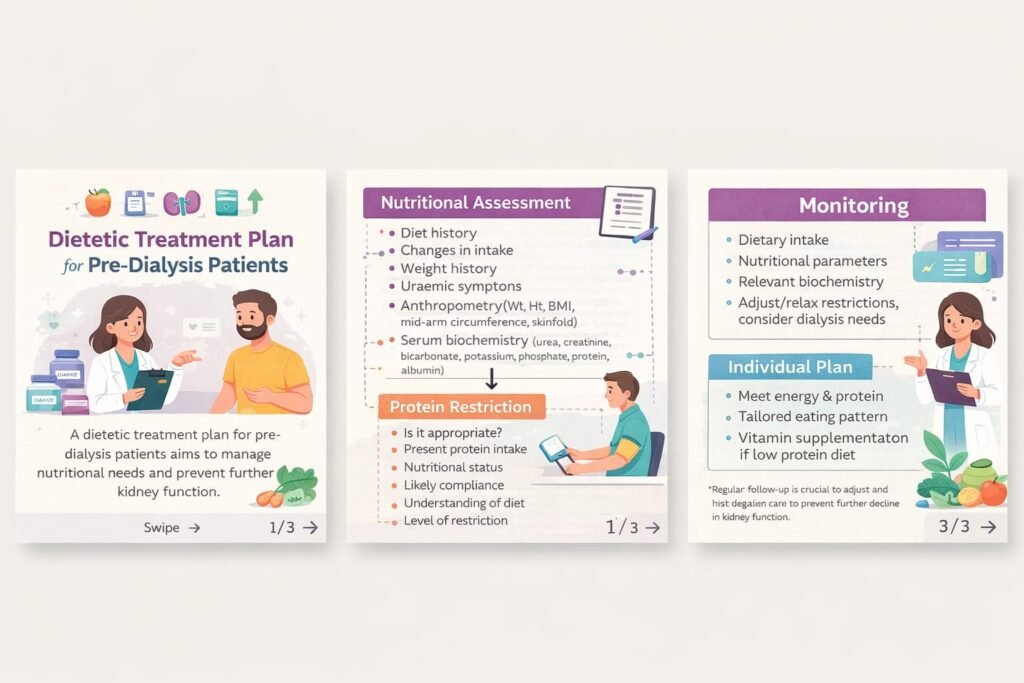
Dietary plan by Clinical Dieitian Nutritionist Geetanjali Mengi for dialysis patients.
Protein restriction will rarely be advised although patients with high intakes may need to modify these. Dietitians should be available in all low clearance or pre-dialysis clinics to give individual advice.
Strategies for achieving nutritional aims
Energy
HD
Patients generally have more difficulty achieving recommended energy intakes. This group more frequently needs advice aimed at increasing their energy intake, either using energy-rich foods or prescribed energy supplements.
PD
Normal or overweight patients may require energy restriction to compensate for the additional calories absorbed from dialysate. Initial advice should concentrate on reducing excessive intake of fats and sugar (provide few nutrients other than energy). Excessive use of hypertonic dialysate to control fluid balance will increase energy intake. Fluid management and sodium restriction should then be emphasized.
Protein
HD
Patients generally have sufficient intake of protein once energy requirements are attained. Combined energy and protein supplements, or intradialytic parenteral nutrition may help.
PD
The high protein requirements are often difficult to achieve by diet alone, particularly those with poor appetite, or during and after peritonitis. Specific targets for protein-rich foods and snacks, and use of prescribed protein supplements may be required.
Potassium
HD
Formal dietary K⁺ restriction is usually required, but the level of restriction is partly dependent on residual renal function. Non-dietary causes of hyperkalaemia should be excluded.
Restriction of dietary K⁺ intake is generally staged following review of the serum levels after each level of restriction.
• Advice on suitable cooking methods (as K⁺ is very water soluble):
Avoid double boil method for cooking vegetables
Parboil vegetables before adding them to stews, soups, etc.
Avoid pressure cooker and microwave cooking (but reheating is permitted)
• Limit portion size and quantities of fruit and vegetables.
Non-dietary causes of hyperkalaemia
Metabolic factors
Hyperparathyroidism, acidosis, insulin insufficiency
PD
Dietary restriction is rarely needed in PD because of continuous clearance.
Phosphate
HD and PD
Clearance of phosphate is not particularly effective with either PD or conventional HD. Daily dialysis and nocturnal dialysis achieve significantly better phosphate clearance, enabling patients to relax their dietary restrictions and reduce their use of phosphate binders. Management consists of dietary restriction of phosphate-rich foods, review of excessive protein portions and foods with added phosphate-containing additives (polyphosphates).
HERE ARE – Phosphate rich foods include:
• milk
• cereals
• dairy products
• cheese
• chocolate
• dried fruit
• eggs
• fish (bony)
• shellfish and seafood
• beans and pulses
• nuts
• meat and poultry
Vitamins
HD and PD
Vitamin deficiency can occur in CRF due to dietary restriction, dialysis losses, and abnormal metabolism. However, deficiency is rare.
Iron
HD and PD
Anaemia is common in CRF, due to a relative lack of erythropoietin, which develops when GFR falls to <35 mL/minute, and should be investigated if Hb <12 g/dl (♂ and post-menopausal ♀) and <11 g/dl (pre-menopausal ♀).
MineraLS and its trace element
HD and PD
Of the 14 essential minerals and trace element deficiencies in Zn, Cu, Mn, and Cr have been reported in CRF mostly due to dietary restriction and drug interactions. Deficiency should be confirmed before starting supplementation.
Fluid and sodium
Fluid management in ESRF is influenced by the degree of residual renal function and mode of dialysis. Patients with substantial residual renal function (>1 L/day) do not usually require a strict fluid or Na⁺ restriction. Patients with reduced urine output should restrict their daily volume of urine plus 500 mL (insensible losses). Salt intake should be restricted to 80–100 mmol/day .
Hypertensive patients should have more aggressive Na⁺ restriction. Patients should be educated about salt as the major driver to thirst, as restricting Na⁺ intake is likely to lead to better fluid control than attempting to restrict fluid intake per se.
HD patients are usually anuric and often require severe fluid restriction (500 mL/day) and adjunctive Na⁺ restriction. Interdialytic fluid gain should be kept to a maximum total increase of 3% body weight.
PD patients usually lose water by ultrafiltration dependent on the dextrose concentration of dialysate (up to 2 L/day). This is especially important in the anuric patient. The volume of ultrafiltrate may be added to the daily fluid allowance. Use of hypertonic solutions may cause damage to the peritoneal membrane integrity and loss of peritoneal permeability, and weight gain. Use of hypertonic dialysate should be minimized especially in obese patients or those with diabetes or hypertriglyceridaemia. These patients need more stringent Na⁺ and fluid restrictions. Icodextrin dialysate may be especially beneficial.